White-throated Needletail

White-throated Needletail
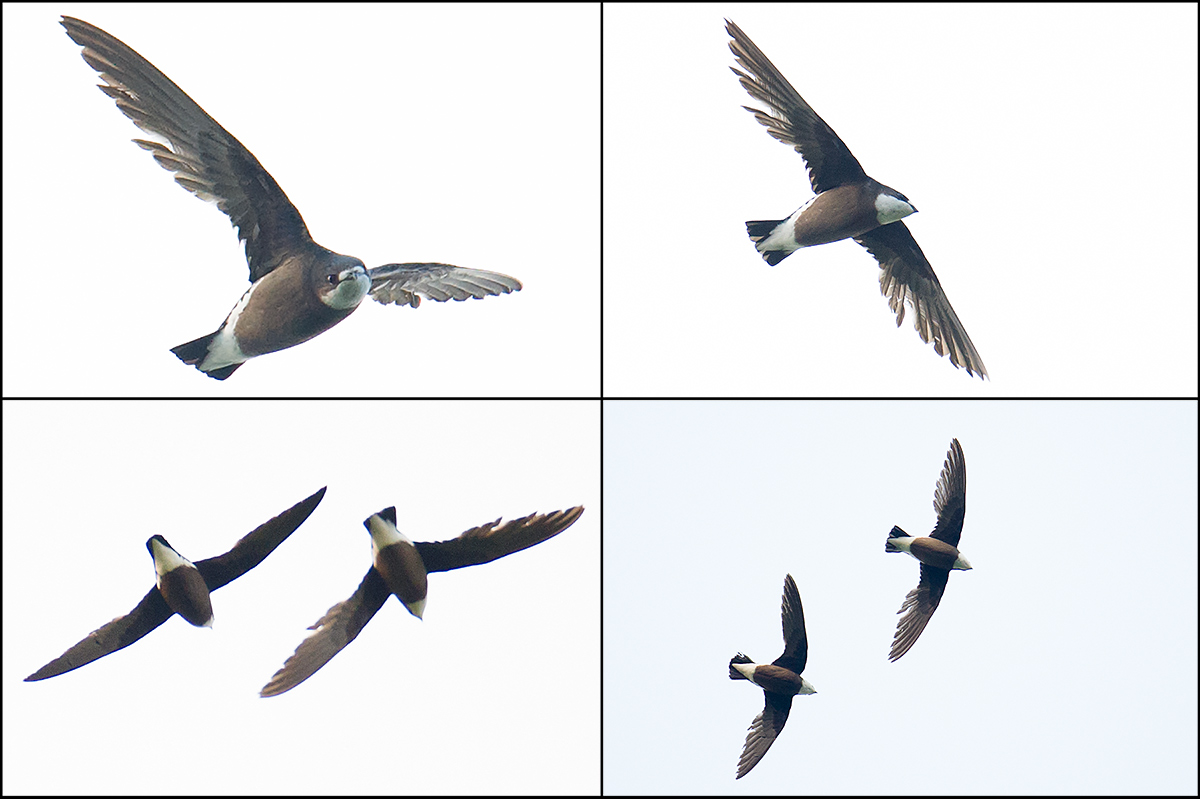
White-throated Needletail Hirundapus caudacutus caudacutus, Yikesama National Forest (52.151914,121.469139), Hulunbeier, Inner Mongolia, China, elev. 1400 m (4,590 ft.), July. White-throated Needletail is a large black and white swift. Nominate breeds Siberia and Russian Far East to Northeast China and Japan. Winters New Guinea and Australia. Rare passage migrant Shanghai. Race nudipes at least partly resident western Himalaya to Sichuan. Flies skillfully and at high speeds over ridges, forests, and lakes. Has square tail and conspicuous white chin, throat, and undertail coverts. Forehead and superloral narrowly white in nominate, black in nudipes. (Craig Brelsford)

Go to Birds of China page

Reach us: info@shanghaibirding.com

Be notified every time we post. Send an
email with “Subscribe” as the subject to
info@shanghaibirding.com

Donate to Shanghai Birding!


3 thoughts on “White-throated Needletail”

  1. I work for an Australian ecological consultancy specialising in ornithology.

    We would like to initiate a project tracking the migration of White-throated Needletail (Hirundapus c. caudacutus) from their eastern Palaearctic breeding distribution through to the non-breeding distribution in Australia.

    I note that in your posts about birding in Heilongjiang, there are very few mentions of White-throated Needletail—even in extensively forested montane areas. Why is that?

    Do you know anyone in northern China who might be interested in collaborating on this sort of project?

    Here is some general background…

    IUCN (Birdlife Int) rates the conservation status of this species as Least Concern with no evidence to suggest a contraction in the range (they consider abundance unmeasurable).

    Most individuals of the northern subspecies seem to migrate to Australia (who knows where the Himalayan species goes!).

    In Australia this species is assessed as Vulnerable due to a continuing decline in abundance (reporting rates and flock size). The decline is attributed to changes in the breeding distribution—probably clearing of large trees with breeding hollows.

    This is one of those species that is far easier to detect in the non-breeding season, when it is in roving flocks, than the breeding season, when it is dispersed in family groups over a vast area, or in the brief migratory seasons when it passes through rapidly, in small groups, at height (with substantial oceanic traverses). Due to the density of observers there are many more records submitted to eBird and similar databases from Australia than from elsewhere.

    There is an existing, ongoing study in Japan (Hokkaido) which has had fabulous results. Thus far they have published results from three birds in 2023 and this has greatly improved understanding of where they go, following a figure 8 route that includes a bizarre pelagic period around the Bonin Islands before backtracking to Korea and coastal China. https://bioone.org/journals/pacific-science/volume-75/issue-1/75.1.3/Light-Level-Geolocators-Reveal-that-White-Throated-Needletails-Hirundapus-caudacutus/10.2984/75.1.3.short

    But Hokkaido is the extreme SE of the breeding distribution and might not show the full range of migratory routes.

    We have a particular concern for collisions of this species with wind turbines—I guess swifts just love wind and wheeling at height!

    Detected collisions are few but they are also hard to find on the ground. Wind farms in development or proposed greatly outnumber those in operation, so we would like to know if this is a threat, and when and under what conditions they are in a particular area (they follow stormfronts in some places). There is a possibility of using camera detection technology and turning off turbines when flocks are around.

    I would be interested to know whether any collisions of this species have been recorded around windfarms in China, in particular Heilongjiang (I think there are many windfarms there).

    There are many people in the Australian ornithology community who are interested in this question, so we are looking at a broad collaboration to make it work.

    1. I am happy to amplify your call for collaborators in your study of White-throated Needletail. I checked my records, and you are right, I have noted the species only a few times in Heilongjiang. The species may be more abundant in the Greater Khingan mountains of neighboring Inner Mongolia. I had more records of the species and higher counts in those mountains.

      Anyone interested in helping Michael should reply to his comment.

      1. Thanks Craig – nice WTNT pics on this page – clear subspecies delimitation.

        Let’s see what comes from that.

        I’m in contact with a couple of groups in Harbin which looks promising.

Leave a Reply

Your email address will not be published. Required fields are marked *

Shanghai Birding 上海观鸟