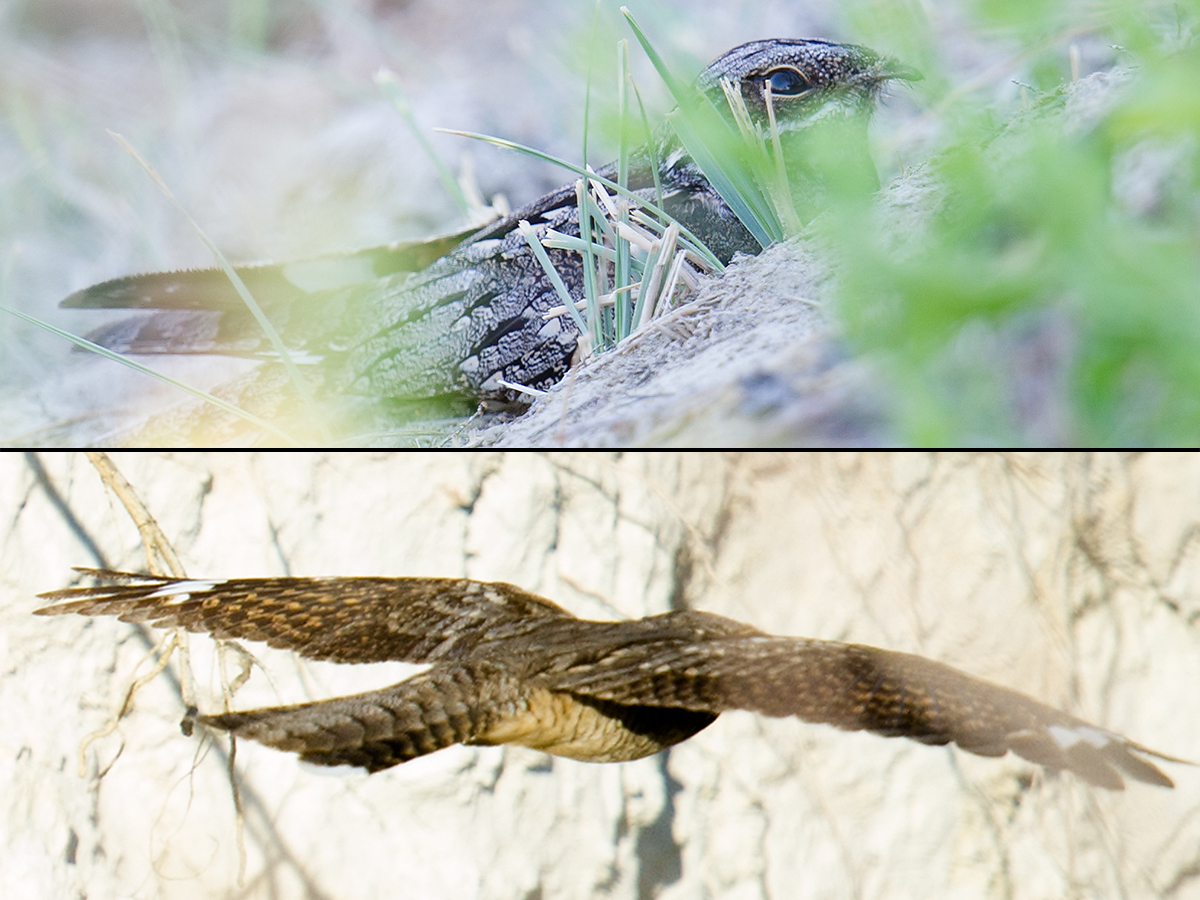
European Nightjar Caprimulgus europaeus breeds Ireland to Mongolia; winters Africa. In China, plumipes eastern Tianshan in Xinjiang across northwest Gansu to northern bend of Yellow River in Inner Mongolia, unwini western Tianshan in Xinjiang, europaeus Altai Mountains in Xinjiang, and dementievi around Hulun Lake, Inner Mongolia. ID & COMPARISON In appearance, but not song, similar to slightly larger Grey Nightjar C. jotaka; this is especially the case with europaeus, the darkest ssp. Other ssp. in China paler, unwini being plainer and greyer (but buff on belly and vent) and plumipes and dementievi more sandy-colored. All show bold black streaks on crown, nape, scapulars, and sides of mantle, and neat, dark barring on underparts (unwini showing the least streaking/barring). Buffish bands most obvious on scapulars/sides of mantle and lesser coverts, but also present on median and greater coverts. Adult male has white spots on wings (buff and nearly absent in female) and corners of tail (lacking in female and first-winter male). Also white submoustachial and patch on sides of throat. Grey Nightjar appears more uniform, with dark markings more evenly distributed and white or buff markings less contrasting. Male Grey Nightjar has white (male) or buff (female) subterminal spots on four outer tail feathers, but male European has white corners formed by white on tips of outer two tail feathers. Egyptian Nightjar C. aegyptius lacks patches on wing or tail (male may show white corners), has overall sandy-grey pigmentation, and lacks dark shoulder and obvious buffish line on scapulars and lesser coverts of European. Underside of primaries paler with noticeable black wing tip (more uniformly dark in European). At close range, crown streaks are finer on Egyptian Nightjar, heavier on European. BARE PARTS Bill black; feet brown. VOICE Distinctive, prolonged, cricket-like chirring song, very different from chuck song of Grey Nightjar. Calls include a rolling, fluty kruii and chuck-chuck calls similar to other nightjars. — Craig Brelsford
THE NIGHTJARS OF CHINA
shanghaibirding.com covers all seven members of Caprimulgidae in China. Click any link:
Great Eared Nightjar Lyncornis macrotis
Grey Nightjar Caprimulgus jotaka
European Nightjar C. europaeus
Egyptian Nightjar C. aegyptius
Vaurie’s Nightjar C. centralasicus
Large-tailed Nightjar C. macrurus
Savanna Nightjar C. affinis
ACKNOWLEDGEMENTS
Daniel Bengtsson served as chief ornithological consultant for Craig Brelsford’s Photographic Field Guide to the Birds of China, from which this species description is drawn.
